Submarine detects strange formations beneath Antarctica before communication is lost
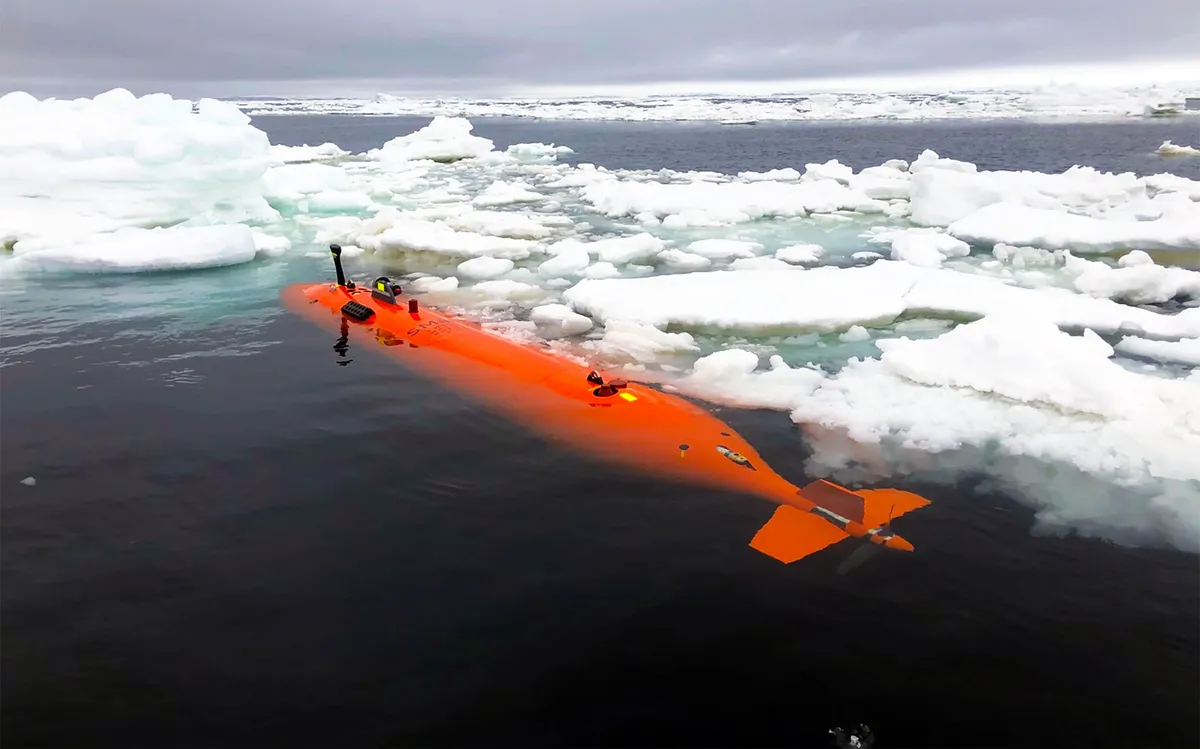
A team of researchers set out in 2022 to probe the hidden world beneath the Dotson Ice Shelf in West Antarctica. Led by Professor Anna Wåhlin from the University of Gothenburg, the mission aimed to explain why the western side of the shelf is melting much faster than the eastern side. The expedition produced detailed maps of the ice shelf’s underside and, sadly, ended with the disappearance of the submersible “Ran”.
Mapping Dotson’s hidden landscape
At the heart of the project was an autonomous underwater vehicle (AUV) called Ran, used to map the underside of the Dotson Ice Shelf. Ran completed 14 missions under the ice, covering 139.66 km² (54 mi²) with sonar. The scans revealed features you can’t see from satellites: flat plateaus, terraced steps and strange teardrop‑shaped pits about 300 metres long and 50 metres deep.
The team found a variety of structures across the shelf. The eastern and central parts showed icy terraces that looked like steps, while the western side was smoother, with channels and scooped depressions. This range of shapes points to different currents and melting processes at work in each area. Warm water pathways, notably the Circumpolar Deep Water, drive extra melting in some spots, with melt channels thinning by 12.2 metres per year.
Ran’s mission and its disappearance
Over a 27‑day campaign, Ran explored the ice cavity to depths of 17.7 km. Because radio and GPS signals can’t pass through thick ice, there was no real‑time communication; Ran navigated using onboard systems and acoustic instruments. It gathered data that glaciologists and oceanographers have used to study how the ice and ocean interact.
On an extension mission to add more data, contact was lost when Ran was an estimated 16.1 km beneath the ice. A concentrated search followed but turned up nothing. Professor Wåhlin described the moment: “To see Ran disappear into the dark, unknown depths below the ice, executing her tasks for over 24 hours without communication, is of course daunting.” Explanations for the loss range from mechanical failure to a possible collision with hidden ice ridges.
What the findings mean and what comes next
The survey revealed large fractures and melt channels that act as conduits—called “hidden highways for ice loss”—carrying heat deep into the ice and speeding up local melting. The results show how narrow fractures and channels can funnel warm water and dramatically worsen local melt, which may contribute more to global sea levels than models had suggested. Between 1979 and 2017, the Dotson Ice Shelf alone added 0.51 mm to global sea levels, while wider losses in West Antarctica have amounted to about 14 mm since 1979.
Adding the newly mapped terraces, fractures and channels into ice‑ocean models should give better forecasts of how West Antarctica will respond to climate changes. The work beneath the Dotson Ice Shelf has started to lift the veil on a previously hidden environment, despite the loss of Ran. The mission highlights the value of exploring these areas to improve our understanding of global sea‑level rise and to inform scientists and policymakers about what needs further attention in these fragile polar regions.